History is often told through extraordinary people and remarkable events. I believe it is more often preserved in ordinary objects simply made to be used, played with, and marveled at, and eventually forgotten. Like a tin robot.
Yet something remarkable happened. It quietly witnessed childhood.
My drawings are not celebrations of rarity, collectibility, or nostalgia for nostalgia's sake. They are portraits of memory I call American Material Memory. By isolating familiar objects and rendering them with extraordinary care, I invite viewers to slow down long enough for forgotten moments to return. The drawing becomes less about the object itself and more about the life it quietly remembers.
From the Artist
As I've said, I’ve always loved the optimistic design of Japanese tin robots.
They were brightly colored, adorned with simplistic moving parts, flashing lights, and swinging arms. Looking back, I realize they represented a completely different way of thinking about design. They embraced bold color, playful engineering, and imagination—but they still followed the same factory formulas.
While researching 1960s design, I came across Volkswagen's famous advertisement featuring a Beetle assembled from brightly colored body panels. It made me wonder what might have happened if Japanese toy designers had embraced that same playful approach. This drawing is my answer.
The result isn't a restoration of a vintage toy. It's a conversation between two pieces of 1960s design—one that existed, and one that perhaps should have.
Mounted Artwork Description
This original artwork was created in graphite and Prismacolor colored pencil. Following completion, the drawing was carefully trimmed from its original sheet and professionally mounted on Canson XL Mixed Media Paper (98 lb / 160 g/m²), selected to match the original drawing paper. The mounted presentation features clean, precision-cut edges surrounding the original artwork. The graphite retains its characteristic range of soft greys, crisp detail, and natural metallic sheen, while the Prismacolor pencils provide rich, wax-based color and smooth tonal transitions. The artwork is securely adhered to the backing, lying perfectly flat with a clean white border that frames the original drawing without altering the original image.
History is often told through extraordinary people and remarkable events. I believe it is more often preserved in ordinary objects simply made to be used, played with, and marveled at, and eventually forgotten. Like a tin robot.
Yet something remarkable happened. It quietly witnessed childhood.
My drawings are not celebrations of rarity, collectibility, or nostalgia for nostalgia's sake. They are portraits of memory I call American Material Memory. By isolating familiar objects and rendering them with extraordinary care, I invite viewers to slow down long enough for forgotten moments to return. The drawing becomes less about the object itself and more about the life it quietly remembers.
From the Artist
As I've said, I’ve always loved the optimistic design of Japanese tin robots.
They were brightly colored, adorned with simplistic moving parts, flashing lights, and swinging arms. Looking back, I realize they represented a completely different way of thinking about design. They embraced bold color, playful engineering, and imagination—but they still followed the same factory formulas.
While researching 1960s design, I came across Volkswagen's famous advertisement featuring a Beetle assembled from brightly colored body panels. It made me wonder what might have happened if Japanese toy designers had embraced that same playful approach. This drawing is my answer.
The result isn't a restoration of a vintage toy. It's a conversation between two pieces of 1960s design—one that existed, and one that perhaps should have.
Mounted Artwork Description
This original artwork was created in graphite and Prismacolor colored pencil. Following completion, the drawing was carefully trimmed from its original sheet and professionally mounted on Canson XL Mixed Media Paper (98 lb / 160 g/m²), selected to match the original drawing paper. The mounted presentation features clean, precision-cut edges surrounding the original artwork. The graphite retains its characteristic range of soft greys, crisp detail, and natural metallic sheen, while the Prismacolor pencils provide rich, wax-based color and smooth tonal transitions. The artwork is securely adhered to the backing, lying perfectly flat with a clean white border that frames the original drawing without altering the original image.
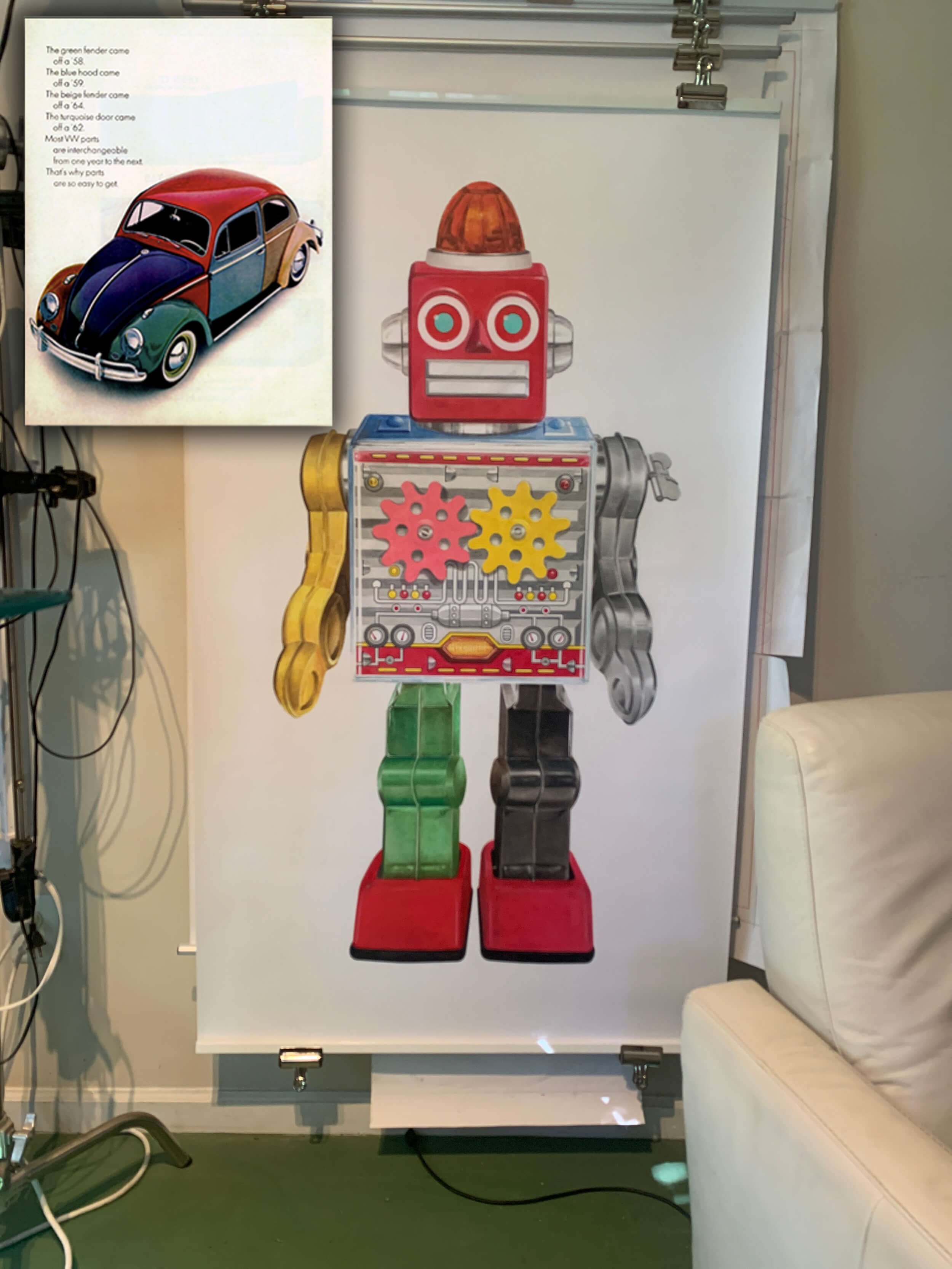 Image 1 of 4
 Image 2 of 4
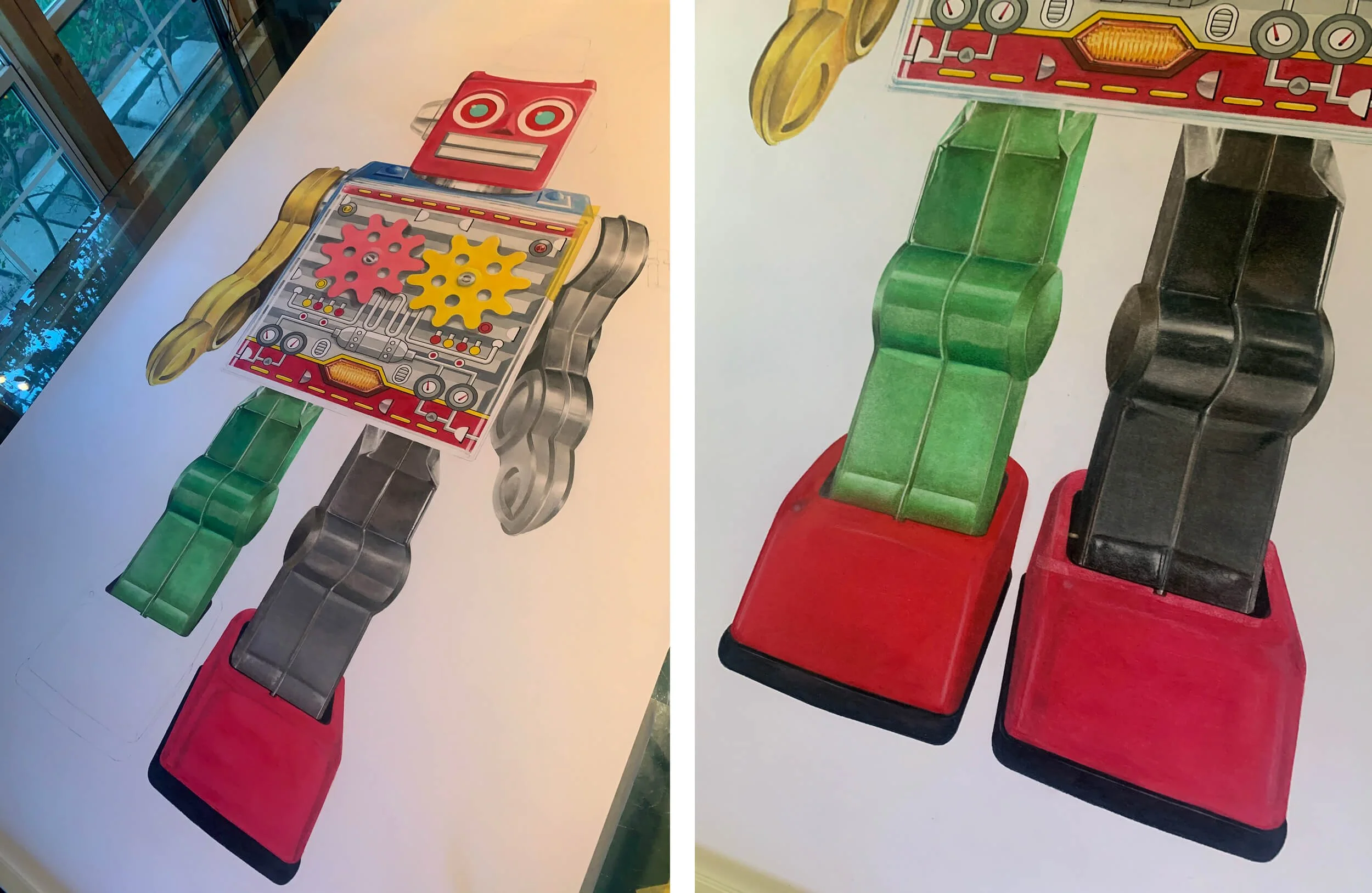 Image 3 of 4
 Image 4 of 4